Opera Essentials: Aida
Our quick guide to Verdi’s powerful and seductive opera.
Quick facts
Who Composed Aida?
Giuseppe Verdi (1813–1901) wrote Aida (1871) for the Cairo Opera House. The premiere was originally intended to coincide with the opening of the theatre, but it was delayed by the outbreak of the Franco-Prussian War. When the premiere finally took place, it was a triumph. Verdi, however, had chosen not to travel to Egypt and took more interest in the La Scala 1872 premiere, which was also a great success.
What is the story behind the opera Aida?
Giuseppe Verdi was commissioned to write Aida by Egypt’s ruler, the Khedive Ismael. Alongside the opening of the Suez Canal in 1869, the opera, and the construction of the Cairo Opera House where it premiered in 1871, were all part of the Khedive’s drive to modernise the country and attract investment overseas. The scenario was provided by Auguste Mariette, an archaeologist from France who was involved in many important archaeological discoveries of the era. Under Verdi’s intense supervision, Antonio Ghislanzoni (librettist of Verdi’s earlier opera, La forza del destino), crafted the libretto. The opera fulfilled its purpose, and remains a monument to the Khedive’s great ambitions. The first European performance took place the following year, at La Scala, Milan, on February 8, 1872 – the first performance Verdi attended in person. Aida has been performed over 500 times at the Royal Opera House, and remains a firm favourite among audiences, with its love story and powerful score.
How long is Aida?
Our current production lasts approximately 3 hours and 15 minutes, including one interval.
What are the famous songs in Aida?
The first big aria in the opera is ‘Celeste Aida’, Radames’ soaring declaration of forbidden love for his Ethiopian prisoner of war. Other highlights include Aida’s poignant prayer, ‘O patria mia’, in which she grapples with her fears for her country in a time of war. The Triumphal March is a moment of huge ceremony, accompanied by trumpets and rousing percussion. There are also poignant duets between the lovers, and, as is often the case in Verdi’s operas, between a father and his daughter, in the powerful Act III scene between Amonasro and Aida.
To find exclusive souvenirs and gifts inspired by Verdi’s opera: explore the Aida collection at the Royal Ballet and Opera Shop.
Trailer
Gallery
Gallery


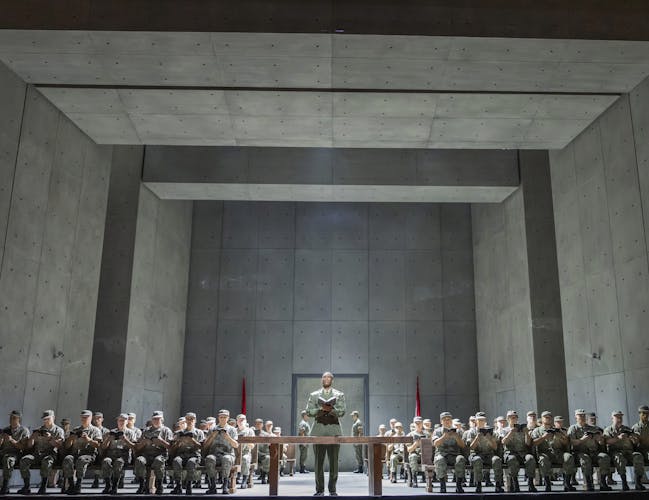

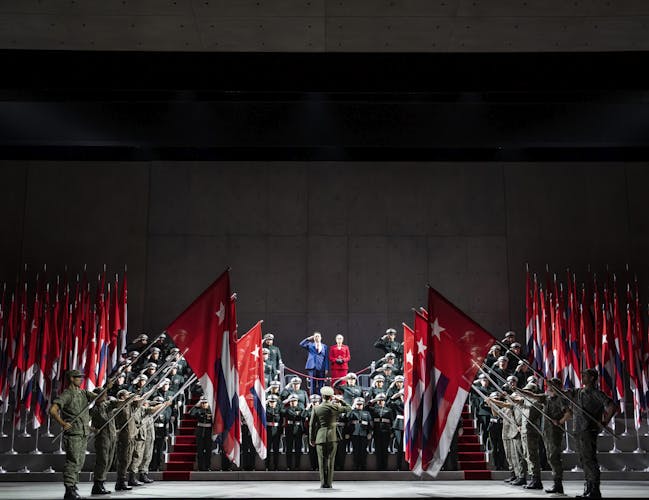
What is Aida about?
Who are the main characters?
At its heart, Verdi’s Aida is a tragic love triangle set in a time of conflict. The Egyptian soldier, Radames, has secretly fallen in love with Aida, an Ethiopian prisoner of war. Aida, the Princess of Ethiopia, has kept her royal identity a secret, as well as the fact that she is in love with Radames. Unfortunately for them both, Amneris, the Princess of Egypt, whom Aida now serves, is also in love with him.
A bitter rivalry
When Amneris begins to suspect what is going on between Aida and Radames, she tricks Aida into revealing her true feelings for him by falsely saying he has died in battle. Amneris reveals the truth, and vows to marry Radames. Meanwhile, Aida’s father, King Amonasro of Ethiopia, pressures Aida to exploit her relationship with Radames for military information. Aida refuses to, but Radames, unaware that they are being observed, unwittingly reveals secret details of the army’s plans, and is branded a traitor.
A love that yearns for peace
Amneris’s plan for vengeance backfires when her father, the King of Egypt, condemns Radames to death by entombment. Radames accepts his fate and goes to a sealed underground chamber, preparing to die alone. There he meets Aida, who has stolen inside: she would rather die with him, than live alone. The last words we (and they) hear are ‘Pace, pace’ (‘Peace, peace,’), sung by the devastated Amneris.
Synopsis
Egypt is at war with Ethiopia. Aida, daughter of the Ethiopian King Amonasro, has been captured and made prisoner. She now serves Amneris, the Egyptian King’s daughter, but Aida has concealed her true identity.
Read full synopsis
The Music of Aida
Structuring a musical monument
The opera is unusual in its construction. Over its four acts, huge choruses and orchestral interludes inviting grand spectacle alternate with intimate scenes between two or three characters. This combination of intimacy and grandeur reflects the story of the piece: the individuals at the heart of the story are crushed by the enormity of the geopolitical events around them.
Highlights
The first big aria in the opera is ‘Celeste Aida’, Radames’ soaring declaration of forbidden love for his Ethiopian prisoner of war. Other highlights include Aida’s poignant prayer, ‘O patria mia’, in which she grapples with her fears for her country in a time of war. The Triumphal March is a moment of huge ceremony, accompanied by trumpets and rousing percussion. There are also poignant duets between the lovers, and, as is often the case in Verdi’s operas, between a father and his daughter, in the powerful Act III scene between Amonasro and Aida.

