Opera Essentials: Peter Grimes
Our quick guide to Benjamin Britten’s stormy operatic masterpiece, Peter Grimes.
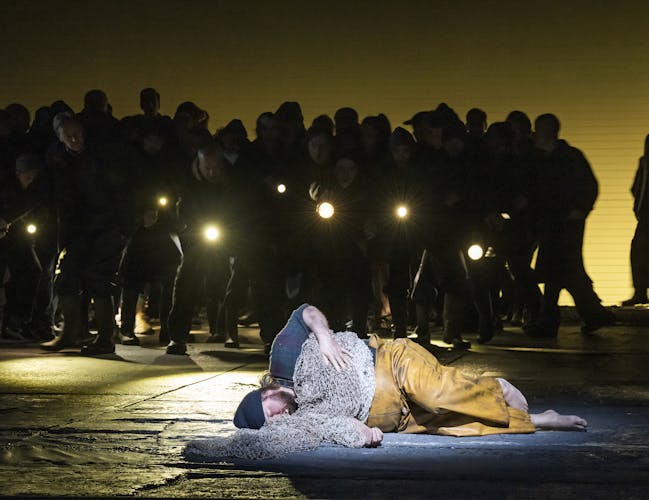
When Peter Grimes, a fisherman in a small coastal town, is accused of mistreating his apprentice, who has died under mysterious circumstances at sea, he faces the judgment and hostility of the villagers. Determined to prove himself, Peter takes on another young apprentice. But against the harshness of the sea and increasing pressure from the village, his fragile grip on reality begins to crumble.
Watch on stage
Quick Facts
What is Peter Grimes about?
Peter Grimes is the story of a fisherman in a small coastal town, who becomes increasingly ostracized from the seaside community when he becomes the subject of its suspicions.
Who composed Peter Grimes?
English composer Benjamin Britten composed Peter Grimes, inspired by poet George Crabbe’s narrative poem The Borough.
What is the most famous music from Peter Grimes?
The Four Sea Interludes is an independent suite made up of the first, third, fifth and second interludes from Britten’s opera, with the respective titles: ‘Dawn’, ‘Sunday Morning’, ‘Moonlight’ and ‘Storm’.
What is the poem ‘Peter Grimes’ based on?
George Crabbe’s ‘Peter Grimes’ section (Letter XXII) of his narrative poem The Borough is a fictional account of a character, Grimes, who is socially cast out of the ‘borough’. The poem is made up of 24 letters, each illustrating different aspects of the small fictional fishing village.
Where is Peter Grimes set?
Like Crabbe’s poem, Britten’s Peter Grimes is set in a small coastal town that bears resemblance to the composer’s own home in Aldeburgh, Suffolk, off the east coast of England.
Gallery
Synopsis
Prologue
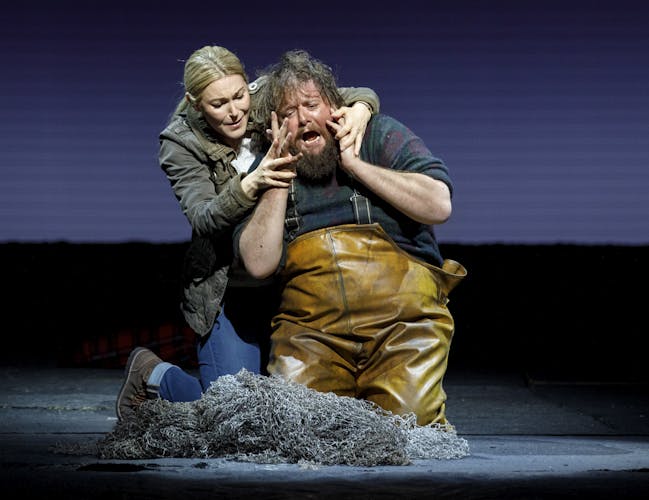
In a dream, the fisherman Peter Grimes relives the recent inquest held into the death of his young apprentice. The coroner has cast an open verdict, leaving the town speculating and gossiping. Ellen Orford, the school mistress, arrives and lulls Peter into a calmer sleep.
Interlude I
Act I
Scene One
When Grimes returns from fishing, only the retired sea captain, Balstrode, and Ned Keene, the local ‘chemist’, are willing to help bring in his boat. Keene tells Grimes that he has arranged for a new apprentice to come and work for him. When asked to collect the boy, Hobson – the carter – refuses, but consents when Ellen offers to accompany the boy on the journey. A powerful storm threatens, during which Balstrode suggests to Grimes that he should leave the town or marry Ellen and change his solitary ways. Grimes rejects his advice, declaring ‘I am native, rooted here,’ and that he will only marry Ellen when he has enough money to earn the respect of the Borough.
Interlude II
Scene Two
With the storm raging outside, the townsfolk are sheltering in the local pub. To the annoyance of Auntie – the landlady – Mrs Sedley, a widow addicted to laudanum, arrives to wait for Ned Keene, her supplier. Auntie’s ‘nieces’ are teasing the inebriated Methodist fisherman Bob Boles, when Ned Keene arrives with the news that part of the cliff has collapsed by Grimes’s hut. To the astonishment of the onlookers Grimes bursts in – as wild as the storm – distracted and disoriented. When a fight threatens to break out between him and Boles, Balstrode calls for a song to calm the atmosphere. The song is interrupted by the arrival of Hobson, Ellen and the new apprentice, soaked to the skin and exhausted from their journey. Instead of allowing him to rest, Grimes insists on taking the boy straight home and carries him out into the night.
Act II
Interlude III
Scene One
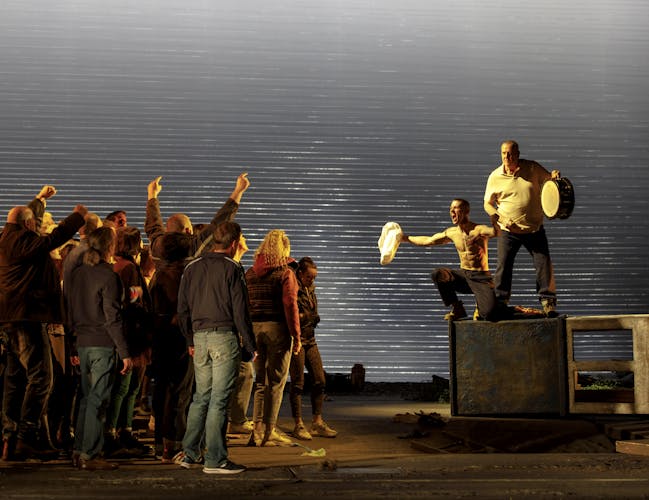
It is Sunday and Ellen has decided not to go to church, but to question the silent apprentice about his life. While trying to encourage the boy to speak, she notices that his clothing is torn and that he has a bruise on his neck. Grimes arrives and orders the boy to go fishing. Ellen intervenes, reminding him that the apprentice is entitled to a day of rest. He loses his temper, pushing Ellen to the ground and running off with the boy. When the locals emerge from church, Bob Boles, who has witnessed this incident, stirs the Borough into action against Grimes. Allowed to vent their anger, the townsmen resolve to set out for his hut to get to the truth – ‘with the branding iron and knife’. They leave Ellen, Auntie and the two Nieces alone on the beach, reflecting on their role and relationship to the men in the Borough.
Interlude IV
Grimes and the apprentice prepare for the fishing trip. Peter is very distracted, fearing that his dream of marrying Ellen is now crushed. When he hears the men from the Borough approaching, he panics and hurries the boy down the steep ladder to the beach. With the knock on the door he hears the boy scream, and fearing an accident, scrambles quickly after him. Reverend Adams, Mayor Swallow, Keene and Balstrode enter the hut and are surprised by its orderly state, but neither Grimes nor the boy are there.
Act III
Interlude V
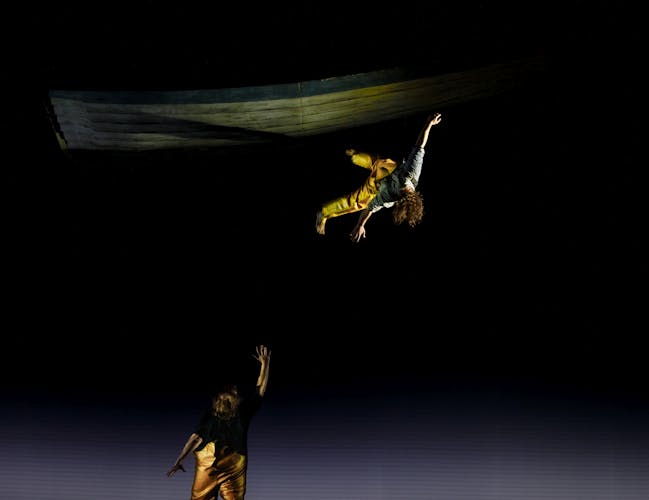
Grimes finds the dead apprentice at the base of the cliff.
Scene One
The annual Borough dance is in full swing. Auntie’s ‘nieces’ are teasing the lawyer Swallow, who, like everyone else, is extremely drunk. Mrs Sedley, re-imagining herself as the local sleuth, tries to convince Ned Keene that Grimes has killed his apprentice. A few days have passed, with no sign of him or the boy. Balstrode arrives with Ellen, who has discovered the boy’s jumper on the tide line. Balstrode tells Ellen that he has seen Grimes’s boat, and together they commit to finding him before the mob do. When they have gone, Mrs Sedley, who has overheard their conversation, incites the Borough to action and the manhunt for Grimes begins.
Interlude VI
Scene Two
Grimes is alone, seized by visions and tortured by the death of the two boys. In the distance is the sound of the mob calling his name. Ellen and Balstrode find him, but in his distressed state, he does not fully recognise them. Balstrode tells him to sail his boat out into deep water and sink it. Dawn breaks and Swallow reports that a boat is sinking out at sea. The Borough turns its back and goes about its business – as it always has, and always will.
—Deborah Warner
Characters
Peter Grimes – a fisherman. Grimes is suspected of murder and subsequently subject to the vitriol of the village.
Ellen Orford – a widow and the schoolmistress of the Borough. Kind and compassionate, she befriends the ostracized Grimes.
Captain Balstrode – a retired merchant sea captain. Balstrode is another of Grimes’ few friends, who offers guidance to Grimes with the help of Ellen Orford.
Swallow – a lawyer and a magistrate, Mayor of the Borough.
Ned Keene – an apothecary and quack. He finds a new Apprentice for Grimes after the first dies.
Mrs Sedley – a widow of an East India Company factory. She is the town gossip, and gets her pills from Ned Keene
Background
In 1941, while living in the US, Benjamin Britten encountered E. M. Forster’s article ‘George Crabbe: the Poet and the Man’ in the BBC magazine The Listener. Taking an interest in Crabbe’s narrative poem The Borough, which has a section titled ‘Peter Grimes’, Britten was inspired to write an opera based on the title character, a fisherman who is suspected by his fellow townsfolk of murdering his young apprentices. Britten’s idea came to fruition when he received a generous commission to write an opera from the Russian-American conductor Serge Koussevitzky, to whose late wife Peter Grimes would later be dedicated.
By 1944, Britten and tenor Peter Pears (Britten’s partner and frequent collaborator) had returned to Britten’s home in Suffolk, where the composer spent most of his time working on Peter Grimes. Shortly after Pears joined the Sadler’s Wells Opera Company, the company’s artistic director, Joan Cross, announced her intention to reopen the London theatre with Britten’s opera, with herself and Pears in the leading roles of Ellen Orford and Grimes. Though the opera’s premiere had been planned for Koussevitzky's Tanglewood Festival in the US, the festival had been suspended during World War II, and Koussevitzky waived his contractual rights, giving his blessing to Sadler's Wells.
The making of Grimes had its tumultuous moments, with Britten facing complaints from Company members of supposed favouritism and a general displeasure over the ‘cacophony’ of his score, plus some off-hand homophobic remarks. Britten had initially asked his friend Christopher Isherwood (A Single Man) to write the libretto, but Isherwood declined. Another of Britten’s friends, the writer Montagu Slater, stepped in. Though adapted from Crabbe’s text, Slater’s libretto abandons the poem’s rhyming couplets, introducing diverse speech-rhythms for the individual characters of the Borough. The opera was completed in February 1945 and had its premiere on 7 June to rapturous response. In 1947, Peter Grimes had its Royal Opera House premiere, directed by Tyrone Guthrie, the former general administrator of Sadler’s Wells, and with Pears and Cross reprising their roles.
Music
To cover the scene changes in Peter Grimes, Britten wrote six orchestral interludes, five of which have been independently published. The Four Sea Interludes, Op 33a, is a suite comprising the first, third, fifth and second interludes from the opera, with the titles ‘Dawn’, ‘Sunday Morning’, ‘Moonlight’ and ‘Storm’; the fourth interlude has been published as Op 33b. Britten conducted the London Philharmonic Orchestra in the first performance of the suite a week after the opera's premiere, at the Cheltenham Festival in June 1945. The suite had its London premiere at the Proms in August 1945.
Watch more

Insights: Peter Grimes (2022)
Join members of the cast and creative team as they discuss Deborah Warner’s latest production of Benjamin Britten’s dark and brooding opera.