Elektra
Opera and music
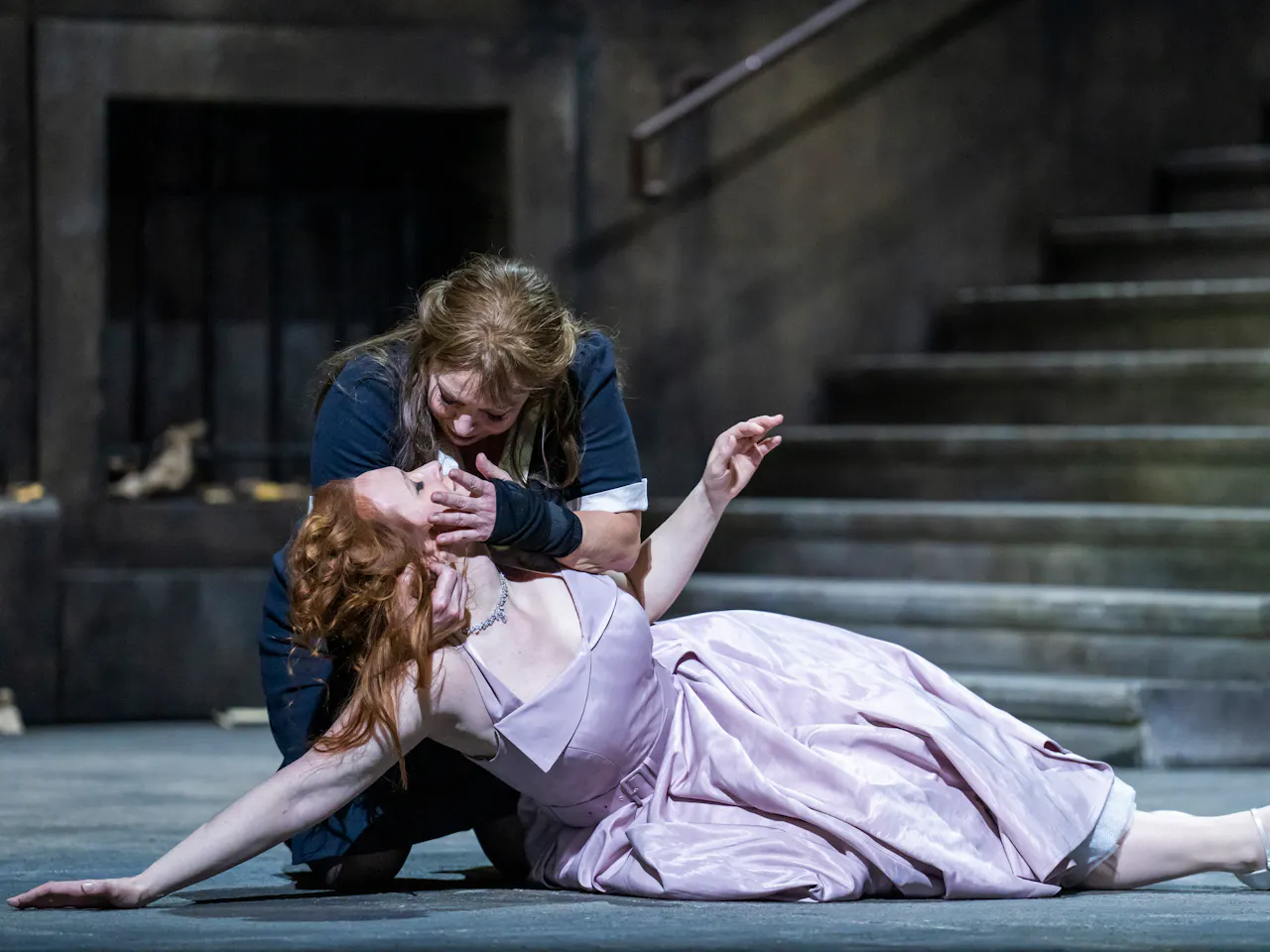
Grief turns into a violent quest for revenge. Christof Loy’s nuanced contemporary production returns for its first revival since its 2024 premiere, with Ausrine Stundyte in the murderous title role. Conductor Semyon Bychkov draws out the fierce drama of Strauss’s menacingly modern music.
Not yet on sale
General booking opens on 10 February 2027
Priority booking dates
Dates
Location
Approximate timings
The performance lasts approximately 1 hour and 50 minutes, with no interval.
Accessibility
- Audio Described
- Captioned
- BSL Interpreted
- Touch Tour
Expand all dates
Monday 12 July, 7.30pm
Thursday 15 July, 8.00pm
Saturday 17 July, 7.30pm
Guidance
Suitable for ages 12+
This productions contains violent scenes, blood and sexual assault.
Language
Sung in German with English surtitles, which are displayed on screens above the stage and around the auditorium.
Generous support from
Exceptional philanthropic support from
Royal Ballet and Opera Principal The Julia Rausing Trust
Generous philanthropic support from
Professor Paul Cartledge and Miss Judith Portrait OBE
Synopsis
The story of Elektra
Vengeance will be hers.
King Agamemnon has been murdered by his wife Klytämnestra and her lover, Ägisth. To protect her brother Orest, Klytämnestra’s daughter, Elektra, sends him away, now living as an outcast in her mother’s home. Though her sister Chrysothemis, desperate to escape the palace, urges caution, Elektra cannot rest until she has avenged her father.
Read the full synopsis
Creatives
The artists and creatives behind the production
Music
Libretto
Director
Designer
Lighting Designer
Discover
With an expressionistic score memorably described by one critic as ‘the colour of blood’, Richard Strauss’s audacious adaptation of the iconic Greek tragedy has shocked and thrilled audiences since its 1909 premiere.
A fruitful collaboration
The composition
Elektra’s composer Richard Strauss and librettist Hugo von Hofmannsthal first met in 1899, at the writer Richard Dehmel’s home in Berlin. Strauss, 35, was a pre-eminent German progressive composer, while the Austrian Hofmannsthal, although ten years younger, had established himself as a leading poet and dramatist. The first surviving letter between the two is dated to 1900, when Hofmannsthal proposed a ballet scenario that he hoped might interest Strauss. The composer declined, citing his own plans to work on a ballet – which he intended to pursue after completing his opera Feuersnot. In the end, Strauss’s ballet did not materialize, but his subsequent interest in Hofmannsthal’s play Elektra (1903) – an adaptation of Sophocles’s original drama – led to further correspondence, and eventually, their first collaboration.
Following Elektra the two built a fruitful partnership for more than two decades, together writing Der Rosenkavalier (1911), the two versions of Ariadne auf Naxos (1912, 1916), Die Frau ohne Schatten (1919), Die ägyptische Helena (1928) and Arabella (1933), plus the ballet Josephslegende and the cantata ‘Tüchtigen stellt das schnelle Glück’ (both 1914). Their collaboration continued right up until Hofmannsthal’s sudden death in 1929, at the age of 55.
Menacing modernity
The music
’Even before a note of the opera was heard, Elektra, like its predecessor, Salome, carried with it the reputation of the play on which it was based,’ writes musicologist Hugo Shirley. ’The orchestral apparatus Strauss gathered for his score – including Heckelphone, a newly-minted relative of the oboe – was unprecedented, as were the demands on the soprano singing Elektra, on stage for all but one of the opera’s seven scenes. And as with Salome, it was an opera whose subject matter placed neurosis and hysteria, brought into the public consciousness by such books as Freud and Breuer’s Studies on Hysteria (1895), centre stage.’
Indeed Strauss’s Elektra is among the most intense and uncompromising works in the operatic repertory, blending extreme emotional expression with complex orchestral language. Dense, dissonant and as Shirley notes, psychologically-driven, the score creates an immense and often stifling aural landscape: violent outbursts, fractured harmonies and relentless tension mirror the obsessive mind of the opera’s heroine, her tormented inner life laid bare in a frenzied juxtaposition of explosive climaxes and eerie stillness. The result is a landmark of modern opera: one that is as visceral as it is musically masterful.
Gallery


Accessibility and resources
There is lift access and step-free routes to over 100 seats in the Stalls Circle, Balcony and Amphitheatre. Some seats in the Stalls Circle, Balcony, Amphitheatre and the Donald Gordon Grand Tier are accessed by 9 steps or fewer. There are 10 steps or more to accessible seats in the Orchestra Stalls.
You can use the assistive listening systems in our auditoriums. Surtitles, captions and translations in English are displayed on screens above the stage and around the auditorium.
Join our Access Scheme for priority access to tickets and to inform us of your access requirements.
See our Accessibility page for more information, watch a subtitled information video on YouTube or view a visitor guide (PDF, 12.0 MB).
Be the first to know
Sign up to hear the latest Royal Ballet and Opera news, receive ticket alerts, and discover how to support us.