Opera Essentials: La Fille du régiment
Donizetti’s opera, La Fille du régiment (The Daughter of the Regiment) is a heartwarming tale of love triumphing against the odds.
Marie, who was discovered as a baby on the battlefield, has been raised by the soldiers of the 21st regiment. Now grown up and working as a canteen girl to the regiment, she has fallen in love with Tonio, a Tyrolean peasant, who joins their ranks to be with her. But when Marie’s long-lost mother, the Marquise de Berkenfield enters the picture, Marie is torn between love and duty, as the Marquise tries to set her up with the wealthy Duke of Krakentorp.
Donizetti’s opera La Fille du régiment is a light-hearted comedy, merging dazzling arias, including ‘Ah! Mes Amis’ and its famous 9 high Cs, with a host of charming characters and a touching love story. Read on to find out more about Donizetti’s delightful comic opera.
Watch on stage
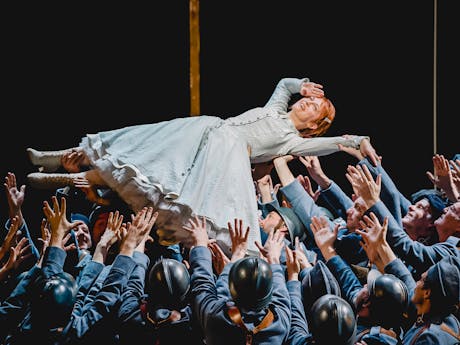
Quick facts
Who composed La Fille du régiment?
Italian composer Gaetano Donizetti composed La Fille du regiment in Paris between 1838-40. The premiere took place on February 11, 1840, at the Salle de Bourse in Paris.
What is the famous song from La Fille du régiment?
Tonio’s aria, ‘Ah, mes amis’ is the most famous aria from the opera. It is a test of vocal agility and prowess for the tenor voice, with its 9 high Cs a literal high point of the opera.
Who is the Duchess of Krakentorp?
The Duchess of Krakentorp (sometimes spelt as Crackentorp or Crackenthorp) is one of opera’s most formidable (potential) mothers-in-law. It is a non-singing role, lending itself to a variety of celebrity cameos over the years. Previous incumbents of the role at the Royal Opera House include Dawn French and Miranda Richardson. Killing Eve Star Sandra Oh recently performed the role at the Metropolitan Opera, in Laurent Pelly’s production.
What is La Fille du régiment about?
La Fille du régiment tells the story of Marie, a young woman who was adopted by a regiment of soldiers as a baby. She has fallen in love with Tonio, a young peasant, but is forced to choose between love and duty when her long-lost mother, the Marquise de Berkenfield, attempts to marry her off to a wealthy Duke.
What genre of opera is La Fille du régiment?
La Fille du regiment is an opéra comique, a genre of French opera combining spoken text and arias. The term opéra comique does not necessarily connote a comic plot (Bizet’s Carmen is one famous example), although in this case, Donizetti’s opera is both comic, and an opéra comique.
Synopsis
Act I
The Tyrolean mountains
The Marquise de Berkenfield and her steward Hortensius have been surprised by the advance of French troops on the very day when they were preparing to flee to Austria. The Marquise finds herself among a crowd of villagers. The men are armed, while the women pray to the Virgin. Possibly in answer to their prayers, the French retreat from the mountain, to the relief of the Marquise, who goes off to rest.
Left alone, Hortensius finds himself facing Sulpice, sergeant in the 21st Regiment. Although petrified, the steward obtains a pass for himself and his mistress. Sulpice is joined by Marie, the daughter the regiment adopted after finding her on a battlefield as a baby. The whole regiment acts as her father, and recently, Marie has become their mess-girl.
But for some time Marie has been seeing a Tyrolean partisan, Tonio, and Sulpice is by no means in favour of this new attachment of his daughter’s. Marie is in love, but disheartened, and she and Tonio have decided never to see one another again. However, the whole regiment enters, bringing the Tyrolean, who has risked his life to come and join Marie. Marie steps in to save Tonio, just as he saved her life when she was about to fall off a cliff while picking flowers. Tonio toasts his new friends, and Marie sings the regimental song. The regiment leaves, taking Tonio with them, but he quickly escapes and comes back to Marie. Sulpice surprises them, and Marie has to tell Tonio that she can only marry a soldier from the 21st. Tonio is not going to give up.
Sulpice agrees to the Marquise de Berkenfield ’s request for an escort to take her to her castle. But Sulpice recognizes the name Berkenfield from the letter found near the young Marie on the battlefield. It emerges that the Marquise is the mess-girl’s aunt. Shocked by Marie’s manners, the Marquise decides to take her niece off to her castle to give her a proper education. By a stroke of bad luck, Tonio has only just signed up with the French. The regiment agrees to let him marry Marie, but she has to leave both the man she loves and her regiment.
Act II
The Berkenfield Castle
The Marquise de Berkenfield is at home in her castle, where she has just completed arrangements for an advantageous marriage between Marie and Duke Scipio of Crakentorp. Sulpice is also at the castle. He is supposed to be helping the Marquise with her plans for Marie’s re-education. Music is part of the curriculum, and today Marie has to sing a song by an Italian composer, but Sulpice goads Marie into misbehaving. The Marquise loses her temper and Marie is miserable. Suddenly the whole regiment, together with Tonio, bursts into the castle. The soldiers carry off Hortensius, while Tonio and Sulpice remain behind with Marie. Tonio asks the Marquise for Marie’s hand in marriage. When she refuses, Tonio decides to reveal what he has discovered from his uncle – that the Marquise is not Marie’s aunt – and he considers abducting the young woman. Alone with Sulpice, the Marquise confesses the truth. She is Marie’s mother, and the girl’s father was a soldier, Captain Robert. Afraid of revealing a liaison that was beneath her, she abandoned her child.
The guests arrive to see the marriage contract signed. Marie refuses to leave her room. The Marquise is at her wits’ end, and the formidable Duchesse de Krakentorp is already growing impatient. Then it occurs to Sulpice to tell Marie the secret of her birth, after which she will no longer be able to refuse. Marie leaves her room, and is ready to sign when, suddenly, all the soldiers, led by Tonio, come crashing in. The guests are aghast at the news that the young woman was a mess-girl, but change their opinion when they hear how Marie feels. The Marquise agrees to her daughter’s marriage to Tonio. Everyone sings a final chorus of Salut à la France.
Characters
Marie – Soprano. Vivandière (a canteen/mess-girl) to the 21st regiment.
Tonio – Tenor. A Tyrolean peasant.
Sulpice Pingot – A sergeant of the 21st regiment, and Marie’s adoptive father.
La Marquise de Berkenfield – Mezzo-soprano. Marie’s long-lost aristocratic ‘aunt’.
Hortensius – Bass. Major-Domo of the Marquise.
Gallery
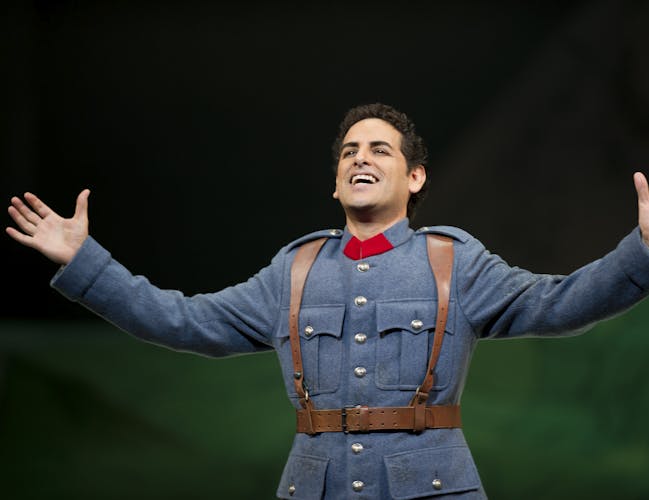
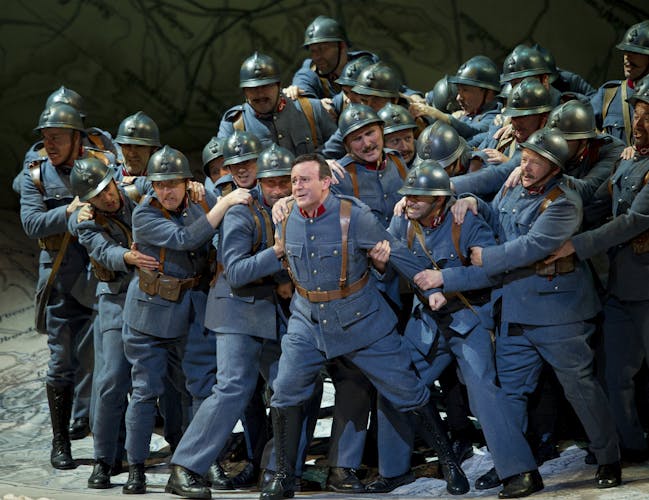
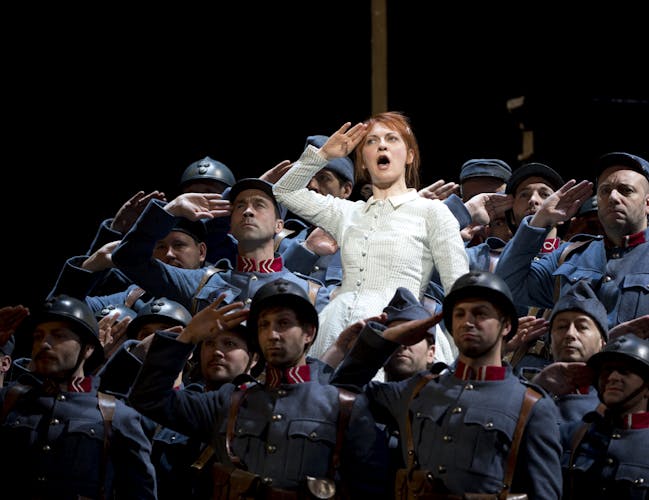
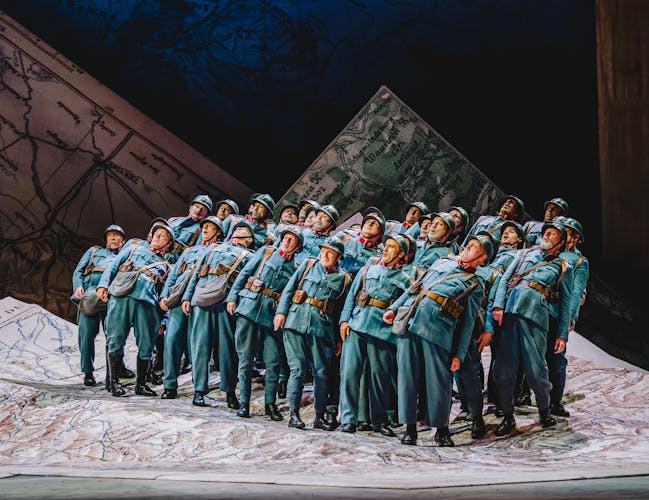
History
La Fille du régiment was Gaetano Donizetti’s first French-language opera. The composer, famed today as one of the founders of the bel canto genre, was born in Bergamo in 1797, and wrote over 70 operas in his lifetime. His most famous operas include the Tudor-themed Three Donizetti Queens series (Anna Bolena (1830), Maria Stuarda (1835) and Roberto Devereux (1837)), the tragedy Lucia di Lammermoor (1835), and the comic operas L’elisir d’amore (1832), Don Pasquale (1843) and La Fille du regiment (1840).
Following the Parisian success of his opera, Lucia di Lammermoor in 1837, Donizetti moved to the French capital in October 1838. There, while staging a variety of other operas across Parisian theatres, he began composing La Fille du regiment for the prestigious Opéra-Comique. The libretto was written by Jules-Henri Vernoy de Saint-Georges and Jean-Francois Baynard, but sadly for Donizetti, the premiere was not a success.
Not only was Gilbert Duprez, the tenor singing the role of Tonio, off pitch, the prominent French composer and critic Hector Berlioz took to the press, criticising Donizetti for his ‘veritable invasion’ of the French opera scene. Despite this, the opera became hugely popular, achieving some 500 performances at the Opéra-Comique alone by 1871.
Music
Donizetti’s score is lively and entertaining, with rousing choruses, catchy tunes, and some jaw-dropping vocal acrobatics. The most famous aria is Tonio’s ‘Ah! Mes Amis’, in which the tenor sings not just one, but 9 high C’s – a note right at the top of the tenor range – as he expresses his joy at being accepted into the regiment. ‘Here I am, a husband and a military man!’
Tonio also has the heartfelt, ‘Pour me rapprocher de Marie’, in which he makes a heartfelt declaration of love to Marie, while pleading with her newly discovered ‘aunt’ the Marquise de Berkenfield for Marie’s hand in marriage. With a simple, soaring melody, rocking strings and expressive woodwind solos, Donizetti immediately creates an impression of respectful determination and radiant love. Tonio sings three verses, each time returning to the opening line and adding further chromatic flourishes. The vocal range is continually expanded upwards, culminating in a high D, and mounting an argument to which it would be difficult to say no (though the Marquise will manage).
The role demands a star tenor who not only has the high notes (a feat in itself) but can deliver them with glorious ease and beauty.
Watch on Stream
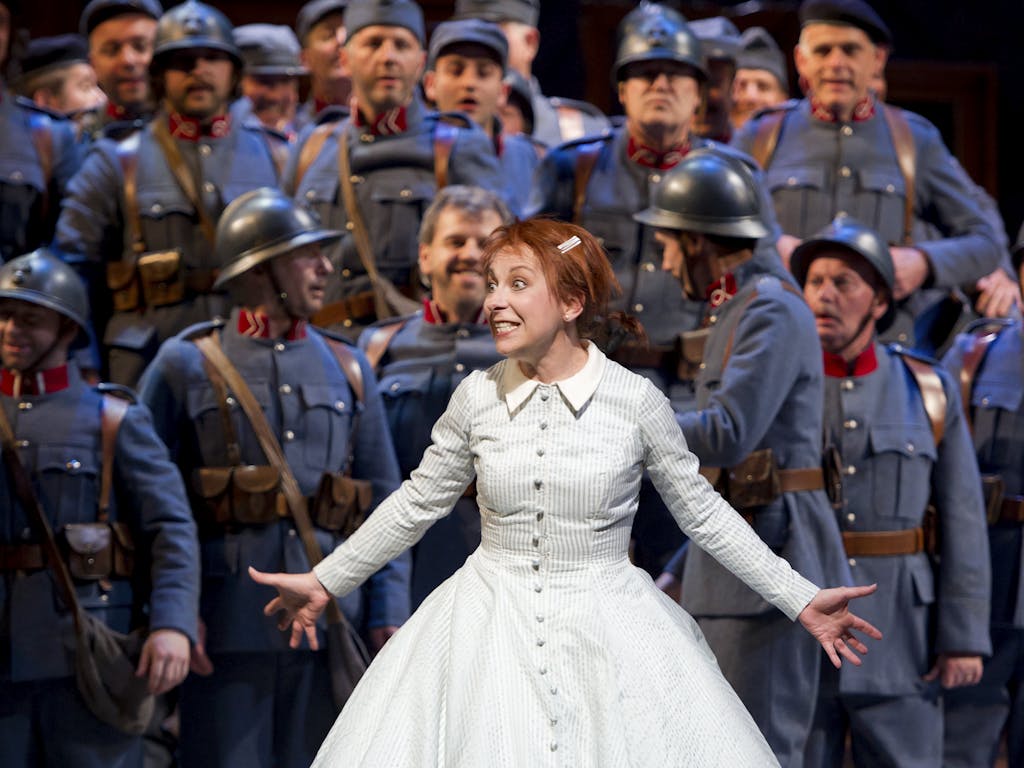
La Fille du régiment (2007)
Watch incredible performances wherever you are, whenever you want, from just £9.99 a month on RBO Stream.
An unusual character
The Duchess of Krakentorp (or Krakenthorp, or Crackentorp, or Crackenthorp...) is a popular speaking role has been played by a variety of celebrities at the Royal Opera House and beyond:
- Dawn French (Royal Opera House, 2019)
- Kiri Te Kanawa (Royal Opera House, 2014)
A singing part was added for the New Zealand opera star, who marked her 70th birthday in the role. After the performance she was given a cake by Jim Carter, her co-star from Downton Abbey.
- Ruth Bader Ginsburg (Washington National Opera 2016)
The late feminist, lawyer and opera lover (known as) RBG, performed the speaking role in 2016. The dialogue was altered to reflect RBG’s own career, including the lines: “The best of the house of Krakenthorp have open but not empty minds. The best are willing to listen and learn. No surprise, then, that the most valorous Krakenthorpians have been women.”
- Montserrat Caballé (Vienna State Opera 2007)
The famous soprano came out of retirement at 74 to perform the role in a Vienna production starring Juan Diego Flórez, adding some Swiss yodelling as a bonus.
- Monet X Change (Minnesota Opera 2023 and Opera Colorado in 2024)
Monet X Change is an American drag queen who appeared on three seasons of RuPaul’s Drag Race. He trained in Opera Performance at the Westminster Choir College of Rider University and performed ‘Vi ravviso, o luoghi ameni’ from Bellini’s La sonnambula on RuPaul’s Drag Race. He is a bass, and an aria was added to the role for him.