Creative Spotlight: Benjamin Britten
Our guide to one of the 20th century’s greatest composers, Benjamin Britten.
Edward Benjamin Britten, Baron Britten of Aldeburgh OM CH (1913–1976), was an English composer, pianist and conductor. He is considered as one of the central musical figures of his generation. One of his many lasting legacies is the revival of British opera. His operatic works include Peter Grimes, Billy Budd, The Turn of the Screw, Death in Venice and the three Church Parables. Outside of opera, Britten composed works including War Requiem (1962), Symphony for Cello and Orchestra (1963) and his only ballet, The Prince of the Pagodas.
Quick Facts
Who was Benjamin Britten?
Benjamin Britten (born Edward Benjmain Britten) was an English composer, conductor and pianist and one of the leading musical figures of his generation. He wrote operas, music dramas, film music, orchestral pieces, hundreds of songs and music for children.
What is Benjamin Britten most famous for?
Britten was famous for his many English-language operas, which include Peter Grimes, Billy Budd, The Turn of the Screw, Death in Venice and the three Church Parables. It was Peter Grimes (1945) that established Britten’s international reputation as one of the foremost composers of his day.
Who was Peter Pears?
Peter Pears was an English tenor and Britten’s muse and partner for nearly forty years. In addition to being the inspiration behind many of Britten’s song cycles, Pears created the role of Peter Grimes in 1945. It was also Pears who suggested that he and Britten create a music festival in Aldeburgh, the town in which they had settled; the first Aldeburgh Festival of Music and the Arts was held in 1948.
Where was Benjamin Britten from?
Britten was born in Lowestoft, a coastal town and civil parish on the east coast of Suffolk, England. His upbringing in Lowestoft – and in a house that looked across the North Sea – greatly influenced his work, particularly Peter Grimes, which is set in a coastal town, with the sea as a central narrative force.
When did Benjamin Britten die?
On 4 December 1976, 12 days after his 63rd birthday, Britten died in his partner Pears’ arms at their home in Aldeburgh. Affectionately known as ‘The Red House’, their home is now a museum and a touching tribute to their life together.
Operas
- Paul Bunyan (1941)
- Peter Grimes (1945)
- The Rape of Lucretia (1946)
- Albert Herring (1947)
- The Beggar’s Opera (1947)
- The Little Sweep (1949)
- Billy Budd (1951)
- Gloriana (1953)
- The Turn of the Screw (1954)
- Noye’s Fludde (1958)
- A Midsummer’s Night Dream (1960)
- Curlew River (1964)
- Owen Wingrave (1971)
- Death in Venice (1973)
Gallery

Early life
Benjamin Britten was born in Lowestoft, Suffolk, to Edith Rhoda Britten (née Hockey), an amateur singer and pianist, and Robert Victor Britten, a dentist. It was a musical household, and Britten’s mother especially encouraged his early attempts to compose. At 15, Britten began composition lessons with the composer Frank Bridge, whose work The Sea had a tremendous impact on the young Britten. Bridge remained an influential mentor throughout Britten’s early career.
Following time at the South Lodge prep school in Lowestoft and Gresham's School in Norfolk, Britten won a composition scholarship at the Royal College of Music. His examiners were the composers John Ireland and Ralph Vaughan Williams. From 1930–33, Britten studied at the Royal College of Music under Ireland and Arthur Benjamin, winning several composition competitions while there. His early successes, composed while at the RCM, included Phantasy, Op.2 (1932) and A Boy Was Born, which was broadcast on the BBC in 1934.
Career
1935 – 1937
In February 1935, Britten was invited to a job interview by the BBC's director of music Adrian Boult. Though unenthusiastic about the prospect of working full-time in the music department, Britten was pleased to receive an invitation to write the score for a documentary film, The King's Stamp, directed by Alberto Cavalcanti for the General Post Office Film Unit. His professional career began as a member of the GPO’s small group of regular contributors, among whom was the poet W. H. Auden. Together, Britten and Auden worked on documentary films Coal Face (1935) and Night Mail (1935) and beyond the GPO, collaborated on the politically and musically radical song cycle Our Hunting Fathers (1936), which was a symbolic cry against a rise in Nazism. From 1935–37, Britten composed nearly 40 scores for the theatre, cinema and radio, with standouts including the film thriller Love from a Stranger (1937), based on a short story by Agatha Christie, and the play Johnson Over Jordan (1939).
In January 1937, Britten’s beloved mother died of a heart attack after falling ill from influenza. On 27 April, his friend, the writer Peter Burra, was killed in a plane crash. Burra had owned a small cottage in Bucklebury and it fell to Britten and one of Burra's closest friends, the tenor Peter Pears, to organize the estate. The two men soon formed a strong friendship that grew into a life-long personal and artistic partnership. Among Britten’s 1937 successes, which included Variations on a Theme of Frank Bridge and Pacifist March – the latter set to words by Ronald Duncan for the Peace Pledge Union, of which Britten was an active member – was The Company of Heaven (1937), whose number set to Emily Brontë’s poem ‘A thousand gleaming fires’, was the first piece of music Britten wrote for Pears.
Though devastated by his mother’s death, Britten, with the money she left behind, was able to buy a disused windmill in the Suffolk village of Snape, which was soon converted into a residence. Britten moved into the mill in 1938, and there hosted many friends including the composers Lennox Berkeley and Aaron Copland, writers Auden and Christopher Isherwood (whose A Single Man has been adapted into a ballet by Jonathan Watkins for The Royal Ballet) and Peter Pears.
1939 – 1942
Britten moved to the US in 1939 with Pears, following in the footsteps of their friends Auden and Isherwood, who had departed three months previously. Britten had intended to reach Hollywood where he had a tentative offer of a film commission, but ultimately settled with Pears’ friend, German emigrée Elizabeth Mayer, in Long Island. When World War II broke out in September 1939, Britten and Pears wanted to return to England but were advised by the British embassy that they would be more valuable in the US, where they could increase British sympathy as arts ambassadors. After the US entered the war, the two tried again for visas, but ultimately were unable to leave until 1942. It was during their stay in America that the relationship between Britten and Pears deepened.
During his American period, Britten produced several works, including his first opera. His Seven Sonnets of Michelangelo (1940) was the first of many song cycles for Pears, while his Violin Concerto, Op.15 had its premiere in New York that same year, by Antonio Brosa and the New York Philharmonic Orchestra. Additional orchestral works from the period included his Sinfonia da Requiem (1940) and An American Overture (1941). Late in 1940, Britten and Pears temporarily moved to a house in Brooklyn Heights, New York City, with several other artistic friends headed by Auden. It was with Auden, here, that Britten collaborated on his first opera (or operetta), Paul Bunyan, Op. 17, based on the American folk tale of a giant lumberjack who founded the nation. Though met with mostly negative reviews upon its premiere at Columbia University in 1941, the operetta was revised by Britten later in his life and was staged at the Aldeburgh Festival in 1976.
In March 1942, Britten and Pears were granted visas to return to England. During the voyage Britten completed A Ceremony of Carols, op.28, a setting of ten ancient carol texts for treble voices and harp, and his Hymn to St Cecilia, op.27 for unaccompanied mixed voice chorus, with words by Auden. Upon arrival home, Britten and Pears registered as conscientious objectors. Though exempt from military service, they were under obligation by the British government to support the war effort through their music: Britten through his composing and Pears through his singing. While Britten set to work on his first full-length opera Peter Grimes, Pears joined the Sadler’s Wells Opera Company (today, English National Opera).
Gallery
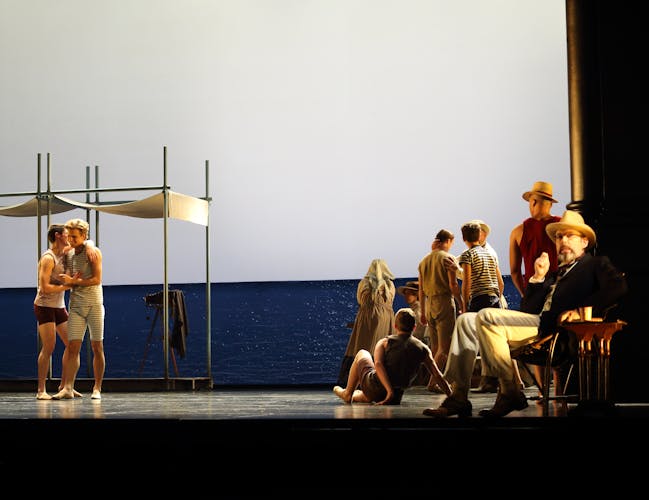
Notable Works
Peter Grimes
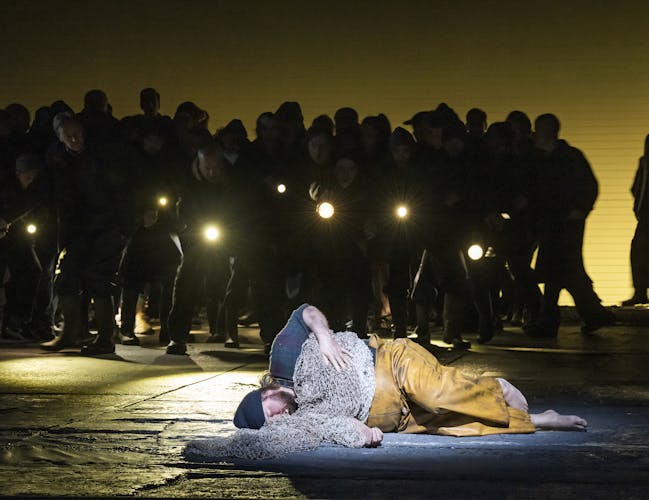
In 1941, inspired by writer E. M. Forster’s article in The Listener, ‘George Crabbe: the Poet and the Man’ and Crabbe’s narrative poem The Borough, Britten began to consider writing an opera based on the character of Peter Grimes – a fisherman who is suspected by his fellow townsfolk of murdering his young apprentices. Britten’s idea came to fruition when he received a generous commission to write an opera from the Russian-American conductor Serge Koussevitzky, to whose late wife Peter Grimes would later be dedicated.
By 1944, Britten and Pears had returned to the Suffolk mill, where Britten spent most of his time working on Peter Grimes. Shortly after Pears joined the Sadler’s Wells Opera Company, the company’s artistic director, Joan Cross, announced her intention to reopen the London theatre with Britten’s opera, with herself and Pears in the leading roles of Ellen Orford and Grimes. Though the opera’s premiere had been planned for Koussevitzky's Tanglewood Festival in the US, the festival had been suspended during the war, and Koussevitzky waived his contractual rights, giving his blessing to Sadler's Wells.
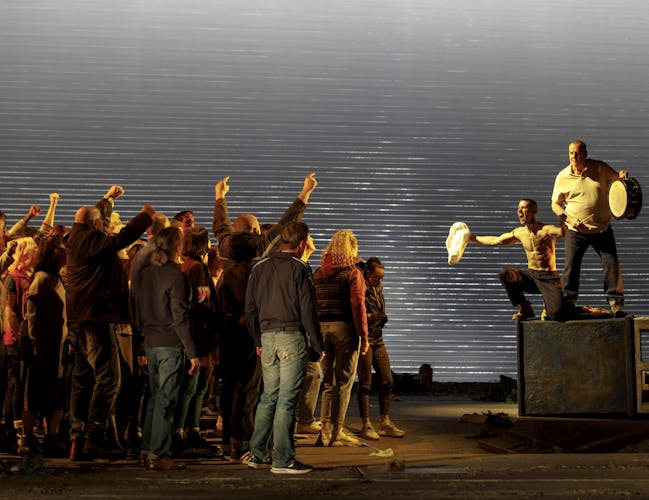
Though Britten faced complaints from company members of supposed favouritism, a general displeasure with the ‘cacophony’ of his score and some off-hand homophobic remarks, Peter Grimes, with a libretto by Montagu Slater (Britten had initially asked Isherwood to write the libretto, but his friend declined), was completed in February 1945. The opera had its premiere on 7 June to rapturous response. Critics hailed the opera as a masterpiece and box-office takings matched or exceeded those for La bohème and Madame Butterfly, staged concurrently by Sadler’s Wells. The work heralded a revival in British opera, with some considering it the most important opera by an English composer since Purcell's Dido and Aeneas. Grimes also confirmed Britten’s reputation as one of the foremost composers of his time.
The Rape of Lucretia and Albert Herring
Britten’s second opera, The Rape of Lucretia, had its premiere at the first post-war Glyndebourne Festival in 1946. Written with librettist Ronald Duncan, the opera was inspired by Livy’s History of Rome and André Obey’s play Le Viol de Lucrèce. It is a retelling of the story of the wife of Collatinus, Lucretia, who kills herself after the Etruscan prince Tarquinius rapes her. Contralto Kathleen Ferrier created the title role, sharing it with Nancy Evans. Following its premiere, Lucretia was taken on tour to provincial cities under the banner of the ‘Glyndebourne English Opera Company’: an uneasy alliance of Britten and his associates with the founder of Glyndebourne, John Christie. The tour lost a significant amount of money, with Christie declaring he would no longer underwrite tours. In 2013, Lucretia was presented by Glyndebourne for the first time since its premiere, in a production directed by actress Fiona Shaw. The production was met with critical acclaim and returned to the festival in 2015. The Royal Opera’s Director of Opera Oliver Mears staged a new production of The Rape of Lucretia in 2022, in the Linbury Theatre.
In 1947, with creatives John Piper and Eric Crozier and singers Pears, Cross and Anne Wood, Britten formed the chamber company the English Opera Group, whose mission was to produce and commission new English operas and works and present them throughout the country. Britten’s next work, the comic chamber opera Albert Herring, with a libretto by Crozier, had its premiere at Glyndebourne in 1947 (though Christie disliked it intensely). Adapted from a short story by Guy de Maupassant and set in the imaginary Suffolk village of ‘Loxford’, Herring is the story of a young man who is crowned May King when it becomes clear that no girl in the village is sufficiently virtuous to be May Queen. The opera had its US premiere at the 1949 Tanglewood Music Festival, before the EOG took it on tour, with The Rape of Lucretia, to Oslo and Copenhagen.
While on their EOG tour of European festivals in 1947, Pears suggested that he and Britten should start a festival of their own in the Suffolk seaside town of Aldeburgh, where Britten had just bought a house. The first Aldeburgh Festival of Music and the Arts was held a year later, in 1948.
Billy Budd
On 1 December 1951, Britten’s Billy Budd had its premiere at the Royal Opera House, Covent Garden, marking Britten’s debut with the Company. With a libretto cowritten by novelist E. M. Forster and Britten’s EOG associate Crozier, Billy Budd was based on Herman Melville’s novella of the same name, about a ‘handsome sailor’ who strikes and inadvertently kills his ship’s master-at-arms John Claggart, who falsely accuses Budd of mutiny. Forster, known for acclaimed novels including A Room with a View (1908), Howards End (1910) and A Passage to India (1924), had taken an interest in the novella, and had admired Britten’s music since he first heard a performance of the play The Ascent of F6, for which Britten composed incidental music. After meeting Britten in 1942, for a performance of the composer’s Seven Sonnets of Michelangelo at the National Gallery, Forster agreed on a collaboration, and he and Crozier set about writing the libretto.
Britten conducted the opera’s premiere in 1951 in its original form of four acts, but in 1960 he revised the score into a two-act version, with a prologue and epilogue, in preparation for a BBC broadcast. The revised version received its first performance at the Royal Opera House on 9 January 1964, conducted by Georg Stolti. Since its revision, Billy Budd has been staged across opera houses worldwide, with a notable 2025 adaptation titled The Story of Billy Budd, Sailor, premiering at the Aix-en-Provence Festival in July 2025, created by director Ted Huffman (Eugene Onegin) and composer Oliver Leith (Last Days).
The Turn of the Screw
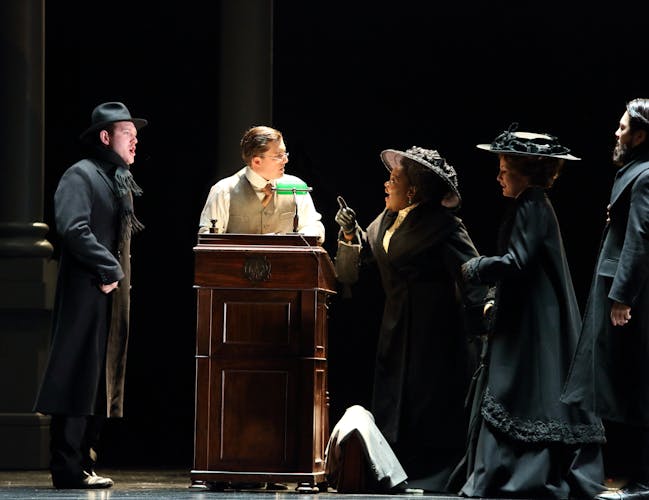
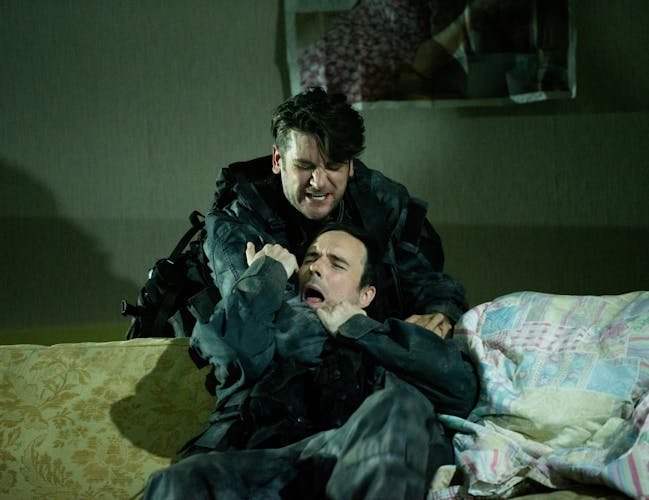
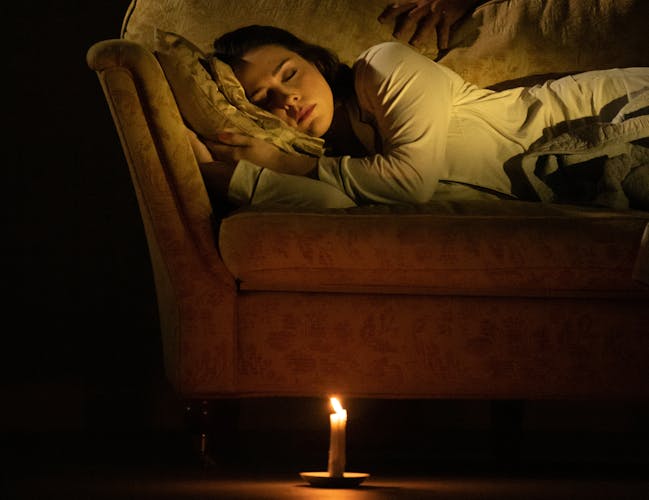
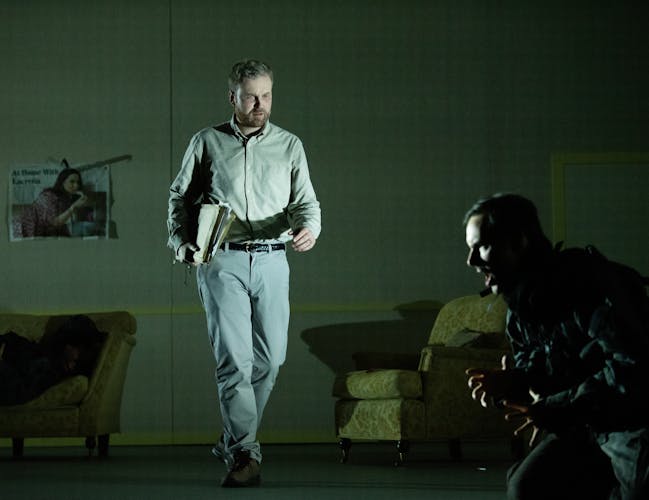
Britten’s adaptation of Henry James’ 1898 novella The Turn of the Screw had its premiere on 14 September 1954, at Teatro La Fenice, Venice. A commission for the Venice Biannale, The Turn of the Screw was written in four months, with Myfanwy Piper (born Mary Myfanwy Piper) as librettist. Like the novella, the chamber opera tells the story of a young Governess sent to a country house to care for two children; there, she gradually becomes convinced that malevolent spirits of the estate’s deceased former servant, Peter Quint, and governess, Miss Jessel, are haunting the children, resulting in a tragic and psychologically turbulent end. Playing on the idea of an infinitely tightening screw, the work is comprised of two acts of eight scenes each, with a prologue that ends with the introduction of a 12-note ‘screw’ theme. Each scene is preceded by a variation on that theme, with accompanying leitmotifs ratcheting up the tension. Peter Pears created the role of Quint (also singing Prologue).
One of Britten’s most successful operas, The Turn of the Screw continues to be performed worldwide, with a new production co-created by Natalie Abrahami (Rusalka) and Michael Levine having its premiere at the Royal Opera House in the 2025/26 Season. James’ original tale has also inspired adaptations beyond the opera world: a 1950 Broadway play preceded Britten’s version, and several films, including The Others (2001) starring Nicole Kidman, as well as a Netflix miniseries, The Haunting of Bly Manor (2020), have drawn inspiration from the psychological thriller. Britten went on to adapt another of James’ works, Owen Wingrave, in 1970, collaborating once more with writer Myfanwy Piper. The two would work together a final time in 1973, for Britten’s last opera: an adaptation of Thomas Mann’s novella Death in Venice.
A Midsummer Night’s Dream
In 1959, Britten and Pears adapted the text of William Shakespeare’s play A Midsummer Night’s Dream into what would become Britten’s eleventh opera (following Noye’s Flood and preceding Curlew River). The two cut away a third of the original play, adding only a single line of text: ‘compelling thee to marry with Demetrius’.
A Midsummer Night’s Dream had its premiere at the Aldeburgh Festival on 11 June 1960, conducted by Britten, directed by choreographer John Cranko (Onegin) and with Pears in the comic role of Flute/Thisbe. Though the work was met with wide critical acclaim, Britten’s estranged collaborator W. H. Auden reportedly dismissed it as ‘Dreadful! Pure Kensington’, following its 1961 Royal Opera House production. Still, A Midsummer’s Dream is one of Britten’s most frequently performed operas today. The 1961 Royal Opera production had 12 performances (seven following the premiere, followed by revival performances in following years), and director Olivia Fuchs staged the company’s latest production in 2005.
Britten and Ballet
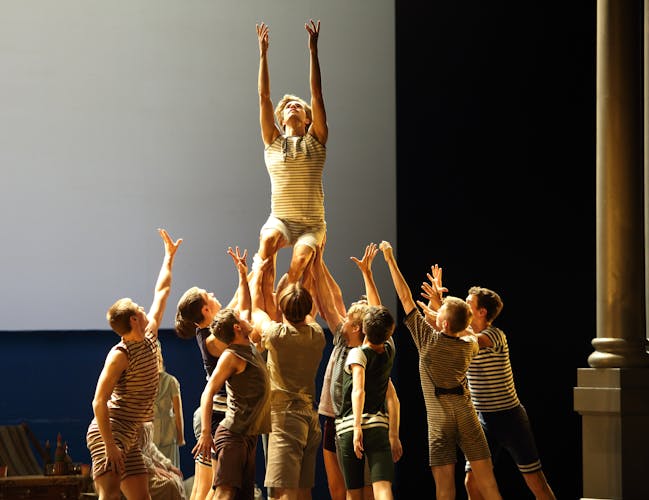
Britten wrote only one full-length ballet, The Prince of the Pagodas, choreographed by John Cranko. The score was commissioned for The Royal Ballet and premiered on 1 January 1957.
Of the other ballets he was commissioned to write there's just Divertimento, adapted from Rossini's Soirées musicales for George Balanchine and the American Ballet Company's 1941 tour of South America and not danced since. There is also an elusive orchestration of Chopin for American Ballet Theatre's Les Sylphides, which has a huge question mark hovering over whether it has ever been performed.
But look closer and there's a lot more to it than that. Throughout his life Britten was fascinated by functional music – 'I want my music to be of use to people' – and dance, of course, was a key part of that. In his operas he drew on the social purposes of dance almost as much as he drew on folk music: we see dance music used to give a sense of community in Peter Grimes, of ceremony in Gloriana, of rambunctious jollity in A Midsummer Night's Dream.
Gallery
Death and Legacy
By 1973, Britten’s health had deteriorated considerably. In the spring of that year, he underwent an operation to replace a heart valve, but it was not entirely successful. From there, his career as an accompanist and conductor stopped, though he continued to compose. His final works include his 1974 Suite on English Folk Tunes op.90 A time there was… and the dramatic cantata Phaedra, written for Janet Baker (Phaedra was given a performance by The Royal Opera in collaboration with The Royal Ballet – Phaedra + Minotaur – in the 2024/25 Season, directed by Deborah Warner in the Linbury Theatre).
On 4 December 1976, 12 days after his 63rd birthday, Britten died in his and Pears’ home in Aldeburgh. Since his death, Britten’s legacy has endured through countless performances of his music, as well as through the Aldeburgh Festival and the composer’s Britten-Pears Young Artist Programme, which he co-founded with Pears in 1972. Britten and Pears’ home in Aldeburgh, affectionally known as ‘The Red House’, is also open to guests, providing a warm snapshot into the life of the composer and his beloved collaborater and partner.